



Honda Pilot Cargo Space & Dimensions: A Row-by-Row Guide
Looking to transport something in a Honda Pilot, but not sure if it will fit within its cargo space? Here’s everything you need to know to assess the situation ahead of time, because there are few moments worse than that frustration-fueled “Now what?” after being unable to get that one-of-a-kind internet purchase safely within the dimensions of the Pilot’s cargo space.
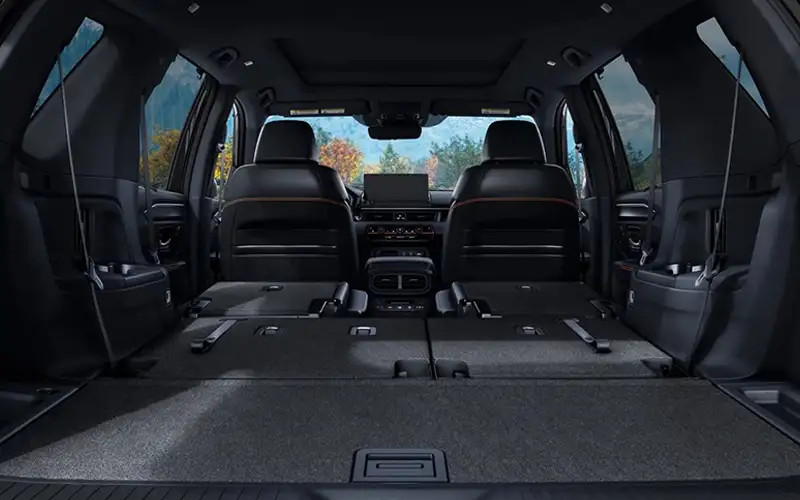
Let’s start by looking at the 2026 Honda Pilot’s different cargo space configurations, because its capacity can vary greatly, depending on how many seats are being used and where they’re positioned. The Pilot offers maximums of 22.4 cubic feet of storage space behind the third row, 60.1 cubic feet with the third seating row folded, and 113.7 cubic feet with all rear seats folded or stowed.
Cargo Capacity Dimension Breakdown
- Behind 3rd Row: 18.6 cubic feet standard/22.4 cubic feet maximum (more than enough for most day-to-day uses, including grocery runs and light travel)
- Behind 2nd Row: 48.5 cubic feet standard/60.1 cubic feet maximum (can include several large suitcases or moving boxes, small furniture, or sports equipment)
- Behind 1st Row: 87.0 cubic feet standard/113.7 cubic feet maximum (potentially for camping gear, bicycles, medium-sized furniture, or several moving boxes)
Why the Official Cargo Space Number Differs From What You’ll Actually Fit
When Honda and other manufacturers report cargo space volume numbers, they typically include all of the vehicle’s interior space, up to the ceiling, and the maximum numbers offered generally account for seating being adjusted to its forwardmost position. However, in any practical application, the available area will be significantly smaller, as it’s unsafe to pile cargo to the ceiling and obscure rear-view visibility, and the presence of passengers might preclude seat adjustment. Oftentimes, third-party tests will account for these issues and report a different figure from the manufacturer.
Smart Storage Features
Beyond merely volume, the Honda Pilot contains several built-in features to remove several of the biggest headaches associated with cargo transportation. These include:
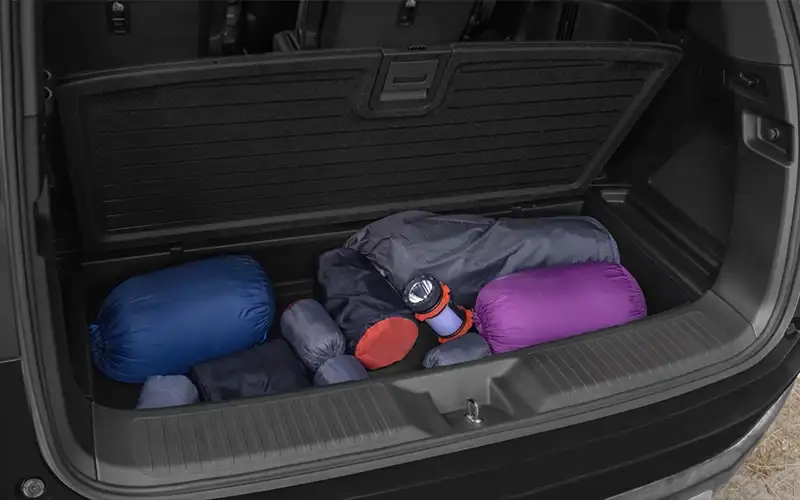
- Underfloor Storage: Just inside the tailgate, a removable floor covers an additional storage compartment that is ideal for hiding valuables from view or keeping wet equipment away from the rest of the cargo.
- Reversible Floor: In the rear cargo area of the 2026 Honda Pilot, the floor panel is reversible. On one side, it has conventional carpet, while the other is easy-to-clean plastic — perfect protection against dripping coolers, swimwear, and other moisture risks.
- Stowable Middle Seat: When the Honda Pilot is configured for eight passengers, the second-row center seat can be removed and stored right under the cargo floor, truly a game-changer when a little extra space is needed in the cabin.
- Programmable Power Tailgate: An invaluable feature when carrying items towards the back of the Pilot, the tailgate can be activated using the key fob, or with buttons inside the cabin and on the tailgate itself. What’s more, the tailgate can be programmed to stop at a certain height to avoid overhead obstacles.
A Standard Third Row
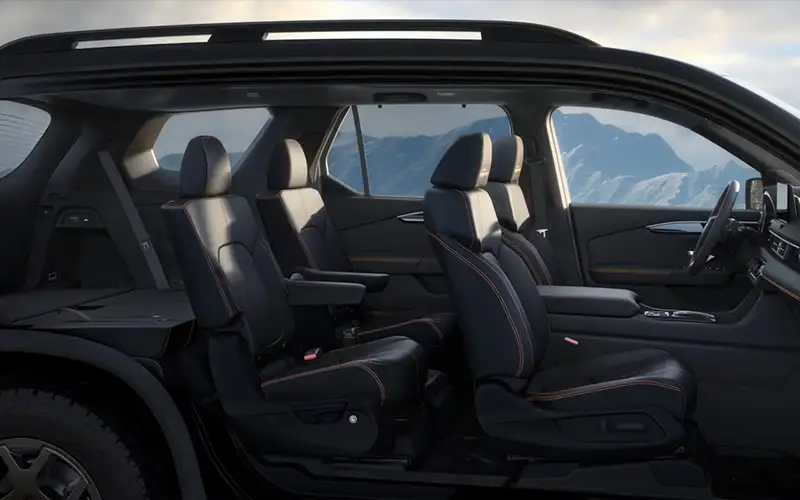
The 2026 Honda Pilot doesn’t just excel at transporting cargo. Thanks to its standard third row, with seating for up to eight people, it’s a fantastic choice for getting families and groups where they need to go. That third row, by the way, isn’t just ornamental. With 39.3 inches of headroom and 32.5 inches of legroom, it has more than enough space for everyone to enjoy their trip.
2026 Honda Pilot Seating Configurations
There is plenty of variation in the seating of the Honda Pilot, with some of that based on trim level, and some based on user preference. Generally speaking, though, all Pilots feature a bench seat in the third row, and one of two second row alternatives:
- Two Captain’s Chairs: Primarily found in the TrailSport trim, but optional elsewhere as well, this setup reduces the Pilot’s capacity to seven while adding comfort features to the second row.
- A Three-Seat Bench: The defining feature here is the removable and stowable middle seat, which can provide additional cargo space, or simply some room to stretch for second-row passengers.
FAQs
The dimensions of the cargo space of a Honda Pilot are 44 inches wide and, with the second and third seating rows folded down, 84 inches long. Therefore, it is not large enough to lay a 4×8 sheet of plywood or drywall flat. However, it may still be possible for the Pilot to haul a 4×8 sheet if angling it and leaving the tailgate open.
A standard queen size mattress measures 60 inches wide and 80 inches long, therefore it is too wide to fit in the Honda Pilot’s 44-inch-wide cargo area. However, a standard twin mattress, which measures 38 inches by 75 inches, will fit.
The Honda Pilot is larger than the Toyota Highlander. The Pilot offers a maximum cargo capacity of 87.0 cubic feet, compared to 84.3 cubic feet on the Highlander, and it also edges out its rival in cargo space with all seats in place, 18.6 cubic feet to 16.0 cubic feet. Additionally, the Honda Pilot can seat up to eight people, versus the Toyota Highlander’s capacity of seven.
Other vehicles comparable in size to the Honda Pilot include the Kia Telluride, the Hyundai Palisade, the Ford Explorer, and the Toyota Grand Highlander. Each of these four SUVs has comparable exterior and interior dimensions, as well as three rows of seating.
The Honda Pilot is considered a mid-size crossover SUV, even though it has seating and cargo capacities that place it near full-size status. At the same time, the Pilot is the largest SUV that Honda manufactures, ahead of other options like the mid-sized Passport and the compact CR-V.